
Induction Kitchen Stove Review: What to Know in 2026
Table of Contents
- Induction Kitchen Stove Performance and How It Works
- Induction Stove Pros and Cons
- Induction Compatible Cookware: What Actually Works
- Induction Range Installation Requirements
- Cleaning, Maintenance, and Long-Term Repair Costs
- Indoor Air Quality and Safety Compared to Gas
- What to Buy Alongside Your Induction Kitchen Stove
- Frequently Asked Questions
Last Updated: September 28, 2026
Induction Kitchen Stove Performance and How It Works
An induction kitchen stove is a cooking appliance that heats pots and pans directly through a magnetic field rather than through a flame or a glowing electric coil.
Induction Stove Pros and Cons
The pros and cons of an induction stove come down to speed and control versus cost and cookware.
Where Induction Wins
- Thermal efficiency. Almost all the energy goes into the pan, not the surrounding air, so the kitchen stays cooler while you cook.
- Responsiveness. Power levels and boost mode react the moment you touch the controls.
- Safety sensors. Pan detection, auto-shutoff, residual heat indicators, and a child lock are standard on most models.
- Easy cleanup. A flat glass-ceramic surface wipes down in seconds.
Where It Falls Short
- Upfront cost. Induction ranges typically cost more than comparable gas or coil-electric models.
- Cookware limits. Aluminum, copper, and most glass pots will not work without a magnetic base.
- Electrical work. Many homes need a dedicated 240-volt circuit, which means an electrician.
- Repair expense. A failed induction coil or control board is a specialist job, not a DIY fix.
Induction Compatible Cookware: What Actually Works
Induction compatible cookware must have a base made from a ferromagnetic material, which in practice means cast iron or magnetic stainless steel. The fastest test is a fridge magnet: if it clings firmly to the bottom of the pan, the pan will work.
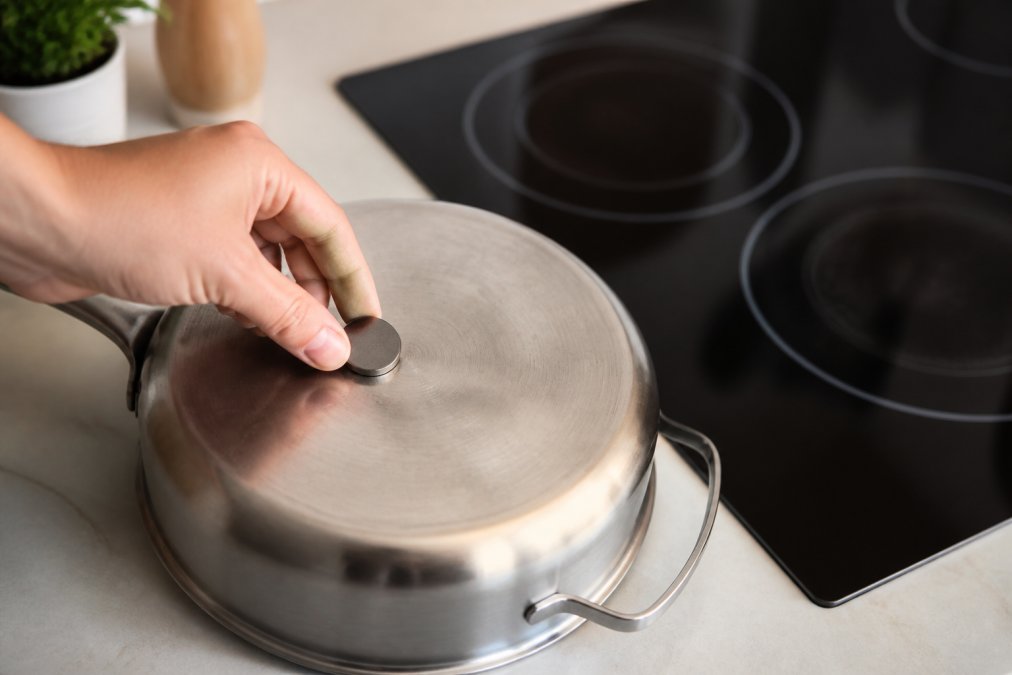
- Magnet test. A strong pull means good magnetic response. A weak, sliding grip means poor performance.
- Base flatness. A warped base makes poor contact and triggers pan detection errors.
- Base diameter. A pan narrower than the coil ring will not heat efficiently.
Induction Range Installation Requirements
- Voltage and amperage. Most freestanding and slide-in induction ranges are rated for a 240-volt supply and draw anywhere from roughly 30 to 50 amps depending on burner count and power output. A 30-inch range with four burners commonly lands in the 40-amp range; larger 36-inch models with a bridge element or a high-output front burner often push toward 50 amps.
- Breaker and wiring. That amperage dictates both the breaker size and the wire gauge. A 40-amp circuit typically calls for 8-gauge copper conductors, and a 50-amp circuit calls for 6-gauge. If your existing range circuit is a 40-amp run and the new range needs 50, the wire has to be replaced, not just the breaker.
- Receptacle type. Electric ranges use a specific 240-volt receptacle configuration, and the plug on the new range must match it. Adapters exist, but a mismatched plug is usually a signal that the circuit itself needs review.
- Dedicated circuit. The range cannot share a circuit with other appliances. If your panel has no open 240-volt slot, adding one may mean a subpanel or a service upgrade, which is where costs climb fastest.
Clearances and ventilation matter too. Respect the manufacturer's minimum spacing to side cabinets and the clearance to any combustible material above the cooktop, and pair the range with a hood rated for its output. Induction throws less waste heat into the room than gas, but it still produces grease-laden moisture that a hood needs to capture.
Cleaning, Maintenance, and Long-Term Repair Costs
Cleaning an induction cooktop is genuinely easier than cleaning gas grates or coil drip pans, but the surface is not indestructible, and the long-term cost picture is the part most reviews skip entirely. This section covers both, because the two are linked: how you treat the glass-ceramic surface determines how long it lasts, and how long it lasts determines whether the higher upfront price actually pays off.
Everyday cleaning
Wipe the glass-ceramic surface with a soft cloth or non-abrasive pad and a cleaner formulated for glass-ceramic once it has cooled. Avoid scouring pads, steel wool, and abrasive powders, which leave micro-scratches that dull the finish and trap residue over time. For baked-on spills, a dedicated glass-ceramic scraper with a fresh blade lifts the deposit without gouging the surface. Sugar and sugary syrups are the exception to the cool-down rule: they can pit the glass if left to harden, so remove them while the surface is still warm to the touch, not hot.
What actually fails, and when
The electronics that make induction work are the components most likely to fail, and they are not user-serviceable:
- The induction coil. Usually the most robust part of the system. Coil failures are uncommon and often trace back to a power surge or a manufacturing defect rather than wear.
- The control board and touch controls. The most frequent failure point. Heat, moisture, and voltage spikes are the usual culprits. A board failure can take out one burner or the whole cooktop.
- The cooling fan. Induction electronics generate heat and rely on a fan to move it out. A clogged or failed fan is a common cause of intermittent shutdowns and error codes.
- The glass-ceramic surface. Cracks from dropped pans or heavy impact are the main risk. A cracked surface usually means replacing the entire glass panel, which is a significant repair.
The cost-of-ownership math
- Upfront cost. Induction ranges typically cost more than comparable gas or coil-electric models.
- Energy cost over time. Induction delivers more of its energy into the pan, so less is wasted heating the kitchen. Over years of daily cooking, that efficiency narrows the upfront gap.
- Repair reserve. Set aside a realistic repair budget rather than assuming the appliance will run problem-free for its full life.
- Replacement horizon. When a control board fails out of warranty, the decision is often repair versus replace. On a budget cooktop, replacement frequently wins; on a premium model, repair is usually worth it.
If you are weighing induction against gas on total cost rather than sticker price, the maintenance and repair profile belongs in the calculation alongside the electrical work. The U.S. Department of Energy appliance standards page on appliance efficiency is a reasonable starting point for comparing operating costs across fuel types.
High-Precision Digital Kitchen & Coffee →
Indoor Air Quality and Safety Compared to Gas
Gas burners produce combustion byproducts, including nitrogen dioxide, directly into your kitchen air, which is why ventilation matters so much with a gas range. Induction produces no combustion at all, so it removes that source of indoor air pollution entirely.
What to Buy Alongside Your Induction Kitchen Stove
A new cooktop changes how your kitchen works, and a few small additions make the transition smoother. Brightvie curates kitchen and smart-home products for exactly this kind of upgrade, and the items below are the ones we see paired most often with a new induction kitchen stove.
| Product | Price | Best For |
|---|---|---|
| High-Precision Digital Kitchen & Coffee Scale | $24.19 | Precise coffee, baking, and meal prep measurements |
| Brightvie Handheld Kitchen Grease Cleaner | $99.99 | Targeting grease and cooking residue on kitchen surfaces |
| Brightvie 3-Tier Rotating Spice Rack | $64.99 | Keeping seasonings visible and within reach |
| Swivel Cabinet Spice Organizer | $34.67 | Freeing up cabinet space for cookware |
| 2-Tier Blind-Corner Cabinet Organizer | $145.45 | Storing pots and pans in awkward corner cabinets |
| Brightvie Kitchen Cleaning & Coffee Warmer Duo | $99.99 | Bundled cleanup and beverage warming |
Frequently Asked Questions
What is the downside of an induction stove?
The biggest downside is cookware compatibility. Pans must have a ferromagnetic base, so aluminum, copper, and most glass or ceramic vessels will not heat. Some cooks also miss the visual feedback of a gas flame, and the glass-ceramic surface can scratch if you slide heavy cast iron across it. Repair costs also run higher than a standard electric coil stove because the induction coil and touch controls are more complex parts. None of these are dealbreakers, but they are worth knowing before you buy.

Do I need special cookware for an induction kitchen stove?
You need induction compatible cookware with a magnetic base. Test any pan by holding a refrigerator magnet against its bottom: if it sticks firmly, the pan will work. Cast iron, most stainless steel, and enameled steel all qualify. Aluminum, copper, and glass do not, unless they have a magnetic plate bonded to the base. Many manufacturers now label pans as induction-ready, so check the packaging or the pan's underside before you commit.
Is induction cooking faster than gas or electric?
Yes, in most cases. Because the magnetic field heats the pan directly rather than the air or the surface around it, boil times drop noticeably. A quart of water that takes eight to ten minutes on a standard electric coil often reaches a rolling boil in four to six minutes on an induction kitchen stove. Boost mode pushes power levels higher for short bursts, which helps with searing and rapid water heating. Exact times depend on your pan's base thickness and the stove's wattage.
Can I install an induction range in any kitchen?
Not always. Most full-size induction ranges need a 240-volt circuit with a dedicated breaker, typically 40 to 50 amps, which is the same setup a standard electric range uses. If you are switching from gas, you will likely need a new outlet and possibly a wiring run, so budget for an electrician. Portable countertop induction burners run on standard 120-volt outlets and need no installation at all, which makes them a low-risk way to try induction before committing.
Are induction stoves energy efficient according to current standards?
They are among the most efficient electric cooking options. Because heat transfers straight into the pan through the magnetic field, far less energy escapes into the surrounding air than with gas or traditional electric coils. That means lower energy consumption for the same cooking task and a smaller carbon footprint over time. The exact savings depend on your local electricity rates and how often you cook, but the efficiency gap is consistent across independent testing.
Switching to induction is one of the more consequential kitchen upgrades you can make, and the electrical requirements and cookware questions are where most people get stuck. Brightvie stocks the kitchen and smart-home essentials that make the transition easier, backed by fast shipping, secure checkout, and a 30-day money-back guarantee. Get started with Brightvie and build a kitchen that works the way you cook.